Foundation 01
The grip
How you hold the club quietly decides everything that follows. Get this right first and the rest of the swing gets easier.
4 min read · Published June 28, 2026 · Updated July 9, 2026
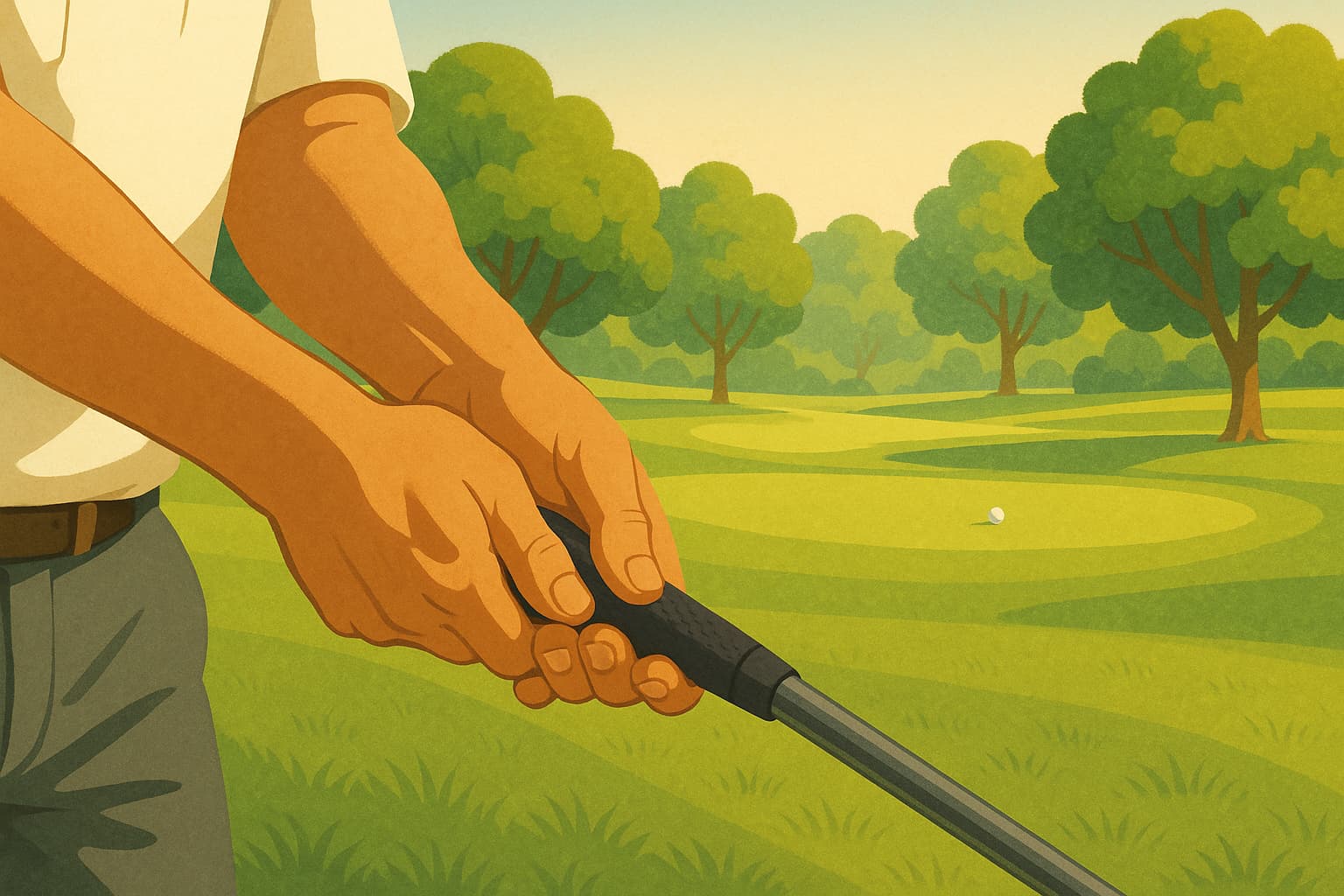
Your hands are the only contact you have with the club, so the grip is the first domino. A good one lets the clubface return to square without any conscious effort; a bad one forces you to make compensations for the rest of your golfing life. Spend real time here — it feels awkward for a week and natural forever after.
Build it in order
- Lead hand first (left hand for a right-handed golfer). Let the club run diagonally across the base of your fingers, not the palm. Close your hand so the thumb sits just right of center down the shaft.
- Check two knuckles. Looking down, you should see roughly the first two knuckles of your lead hand. None means too weak; three-plus means too strong.
- Trail hand covers the lead thumb. The lifeline of your trail hand sits snugly over your lead thumb. The two hands should feel like one unit.
Pressure
Hold it like a tube of toothpaste with the cap off — firm enough that nothing slips, soft enough that nothing squeezes out. On a scale of 1–10, aim for a 4.
The myth that costs beginners distance
You'll hear
Squeeze tightly so the club can't twist in your hands.
What's true
A tight grip floods your forearms with tension and kills clubhead speed. Light, secure pressure lets the wrists hinge and release — that's where easy power comes from.
There's no single "correct" grip style — interlock, overlap, or ten-finger all work. Pick the one that feels secure for your hand size and keep it consistent.
The three grip styles compared
Overlap (Vardon grip): The little finger of the trail hand rests on top of the gap between the lead hand's index and middle fingers. This is the most widely taught style and works well for players with average to large hands.
Interlock: The little finger of the trail hand interweaves with the index finger of the lead hand. Jack Nicklaus and Tiger Woods both use this style. It works particularly well for players with smaller hands or shorter fingers because it keeps both hands from working independently.
Ten-finger (baseball grip): All ten fingers contact the grip with no overlapping or interlocking. Beginners often find this the most natural, and it can be a smart starting point. It's also the go-to for junior golfers.
The functional difference between the styles is smaller than the marketing would suggest. What matters far more is that both hands feel unified and that you don't over-tighten when you take the club back.
How to check your grip at home
You don't need a driving range to practice a good grip. Here are three simple checks you can do in your living room with any club:
- The waggle test. Hold the club at address and gently waggle the head back and forth. If you feel the head moving freely and your forearms stay soft, the pressure is right. If your arms tighten up, ease off.
- The drop test. Hold the club out in front of you at waist height with a neutral grip, then open your lead hand. The club should fall — if it sticks to your palm, you're gripping too deep in the hand.
- The mirror check. Stand in front of a mirror and look at the "V" formed by your thumb and index finger on each hand. Both Vs should point roughly toward your trail shoulder — this is a neutral grip. If they point at your chin, you're too weak; if they point outside your trail shoulder, too strong.
Common errors and what they cause
Too much palm (not enough fingers) on the lead hand — this locks the wrist and prevents the hinge that generates power. The club feels heavy and shots fly low and left for right-handers.
Trail hand wrapped too far under the grip (too strong) — this often causes a hook or a pull-left miss because the clubface closes through impact. It can feel powerful at first, which is why beginners drift toward it.
Grip changing mid-round — many beginners unknowingly re-grip after a bad shot, adjusting a little each time until their setup is completely different by the back nine. Establish a pre-shot routine that includes consciously setting your grip the same way every time.
Practice without a ball
The grip is one of the very few parts of golf you can train at home with zero equipment. Spend five minutes a day just picking up the club, building the grip in order, checking the knuckles, checking the pressure, and setting it down. After a week of this, it becomes automatic. That's the goal — a grip you never have to think about again.
Key takeaways
- Club in the fingers of the lead hand, not buried in the palm.
- See about two knuckles of the lead hand at address.
- Light pressure (a 4 out of 10) — tension is the enemy of speed.
- Any grip style is fine; consistency matters more than which one.
- Practice the grip at home daily until building it becomes automatic.
Keep exploring
What actually matters in beginner clubs
Forgiveness, the right loft, and a half-decent fit beat brand names every time. Here's where to spend attention — and where not to.
Gear HubBeginner sets, an opinionated take
What to look for in a starter set, and the kinds of options that consistently serve new golfers well — with our honest biases on show.