
The ball fell off the tee — does it count?
No. If you haven't made a stroke at it, just tee it up again — no penalty. A whiff (swinging and missing) does count, though.
Rule R 6.2b
Rules & etiquette
The full Rules of Golf are vast. As a beginner you need maybe a dozen — explained in plain English and backed by the USGA & R&A.
Stuck on a ruling mid-round? Search a situation in plain words — works on your phone, no sign-in needed.
Where am I allowed to tee up?
Every hole starts here — and so do the easiest rules to get right.

No. If you haven't made a stroke at it, just tee it up again — no penalty. A whiff (swinging and missing) does count, though.
Rule R 6.2b
A maximum of 14 — count them before you tee off. One too many costs two strokes per hole (max four), not disqualification.
Rule R 4.1b
Say "provisional" out loud and hit another ball before you walk forward. If the first is gone, you're already in play — no walk of shame back.
Rule R 18.3
Ball on the cart path — what are my options?
The general area — where most of your golf happens, and where the free drops live.
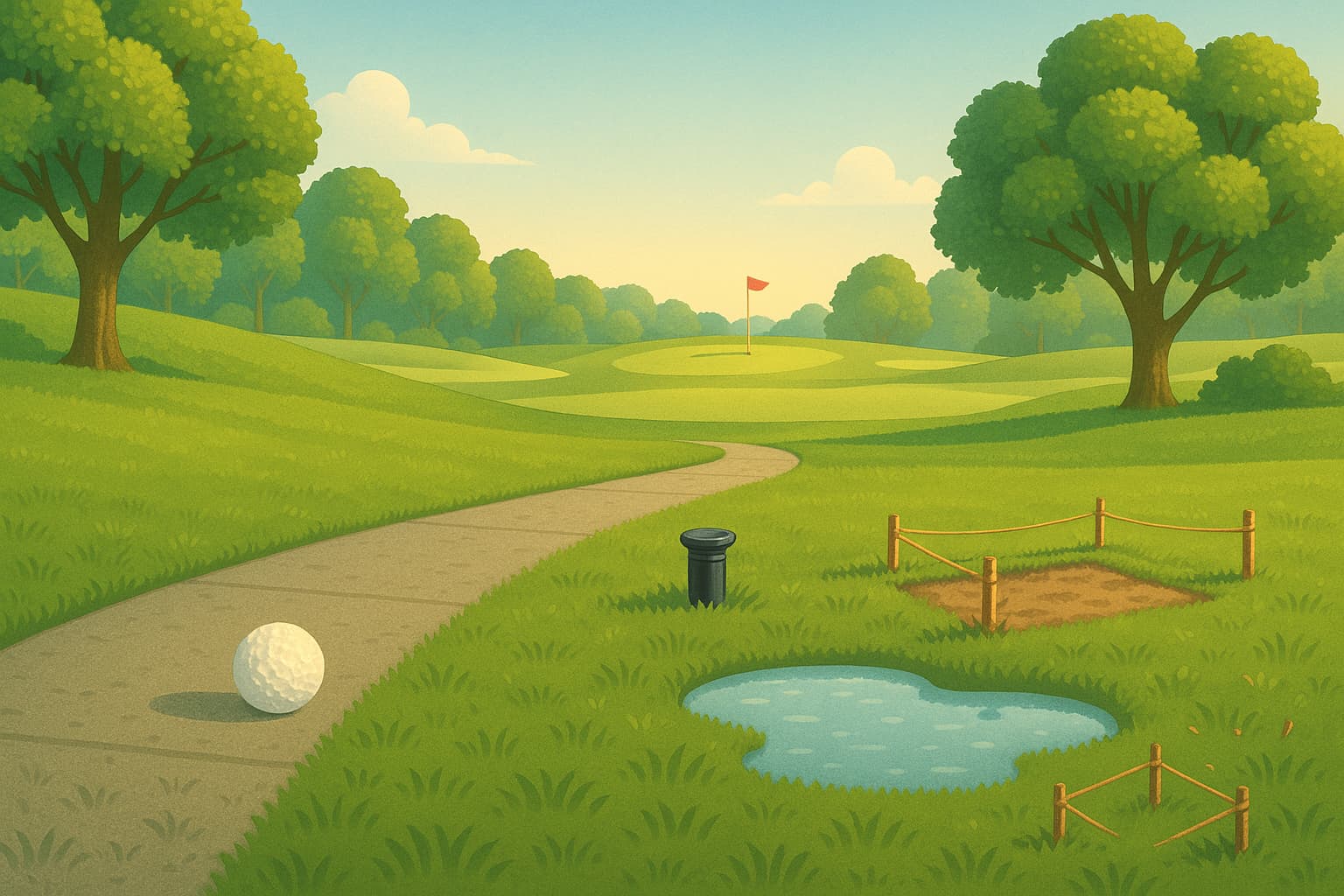
Yes — natural loose impediments can be moved anywhere. Just don't cause the ball to move; if you do, put it back (usually with a penalty stroke).
Rule R 15.1
If wind or gravity moved it, play it from the new spot — no penalty. If you caused it, put it back; that usually costs one stroke.
Rule R 9.2 · R 9.4
One penalty stroke, your pick: replay from the previous spot, drop within two club-lengths (not nearer the hole), or drop back on the hole–ball line as far back as you like.
Rule R 19.2
Unplayable in the bunker — what are my options?
Your ball is in the sand. You have more options than you think — one of them even gets you out without touching sand again.

Yes — rakes are movable obstructions and can be moved anywhere without penalty. If the ball moves while you do it, just put it back.
Rule R 15.2
You can't ground the club right in front of or behind the ball, take practice swings that touch sand, or test the surface. Leaning on your club while waiting is fine.
Rule R 12.2
Ball in the water — what are my options?
Red or yellow stakes mark a penalty area. One stroke buys you out — and red stakes give you an extra escape route.

Both allow replay-from-previous-spot and back-on-the-line (one stroke each). Red also allows sideways relief within two club-lengths. Most modern courses mark nearly everything red.
Rule R 17.1d
What am I allowed to do on the green?
The friendliest place in the rulebook: here you may lift, clean, repair — and leave the flag in.

You must take free relief — playing from another hole's green is not allowed. Find the nearest point off the green (not nearer the hole) and drop within one club-length.
Rule R 13.1f
When is a ball actually out of bounds?
White stakes are the course's hard edge. The rule stings — but a provisional ball takes most of the pain away.

Three minutes from when you start searching. After that it's officially lost — stroke and distance.
Rule R 18.2a
Original stroke + penalty stroke + strokes with the provisional. Example: tee shot lost (1), penalty (2), provisional off the tee (3) — your next swing is your fourth.
Rule R 18.3
What does a correct drop look like?
Every relief ends the same way: a ball dropped from knee height into the right area. Here's the whole craft.

Free relief = one club-length. Penalty relief (unplayable, lateral from red stakes) = two. Measure with the longest club in your bag except the putter.
Rule R 14.3 · R 19.2
The spot you measure from: the nearest point of complete relief (free drops), where the ball lies (unplayable), or where it last crossed the penalty-area edge. Club-lengths start there — never nearer the hole.
Rule R 14.3b
Drop again. If it rolls out a second time, place it where it landed on that second drop. No penalty for any of this.
Rule R 14.3c
What par really means, how a hole is scored, and the names for going over or under — birdie, bogey, eagle and the rest.
1 min read

Out of bounds, water, and unplayable lies — what each costs and where you get to play from, without the rulebook headache.
3 min read

The fourteen-club rule, and why a beginner is better off carrying fewer.
2 min read

The single most appreciated skill of a new golfer: keeping up — here's how, without rushing your swing.
1 min read

The unwritten rules that get you invited back — caring for the course, respecting others, and what to actually wear.
3 min read

Googling the answers to a beginner-course theory quiz? Here are the questions everyone gets stuck on — free drops, pace of play, how many clubs, and par — explained so you remember them on the course.
2 min read
What a handicap actually measures, why every new golfer starts at 54, and how the number comes down — without the math headache.
3 min read

Norway's path onto the course — what the beginner course covers, what the days feel like, what it costs, and what happens the moment you pass.
2 min read
Your privacy
We use a few necessary cookies to remember your language and units. We also show ads to keep the site free — accept to allow personalised ones. Privacy & cookies